Most flips aren't bad luck. They happen in the same few places, for the same few reasons — and nearly all of them are things you can change.
This guide goes through the enclosure piece by piece: walls, floor, furniture, heat. It's the practical companion to why being upside down is dangerous.
One thing to say upfront: you will not eliminate flipping entirely. Tortoises climb — it's normal behaviour, not a fault. The goal is to make flips rare, and to make sure that when one does happen, your tortoise lands somewhere it can recover from.
Start with the walls
This is where most flips begin.
Get rid of the glass
A tortoise that can see out will try to get out. Glass and clear acrylic are the most reliable way to create a wall-climbing habit — and wall-climbing is how most tortoises end up on their backs.
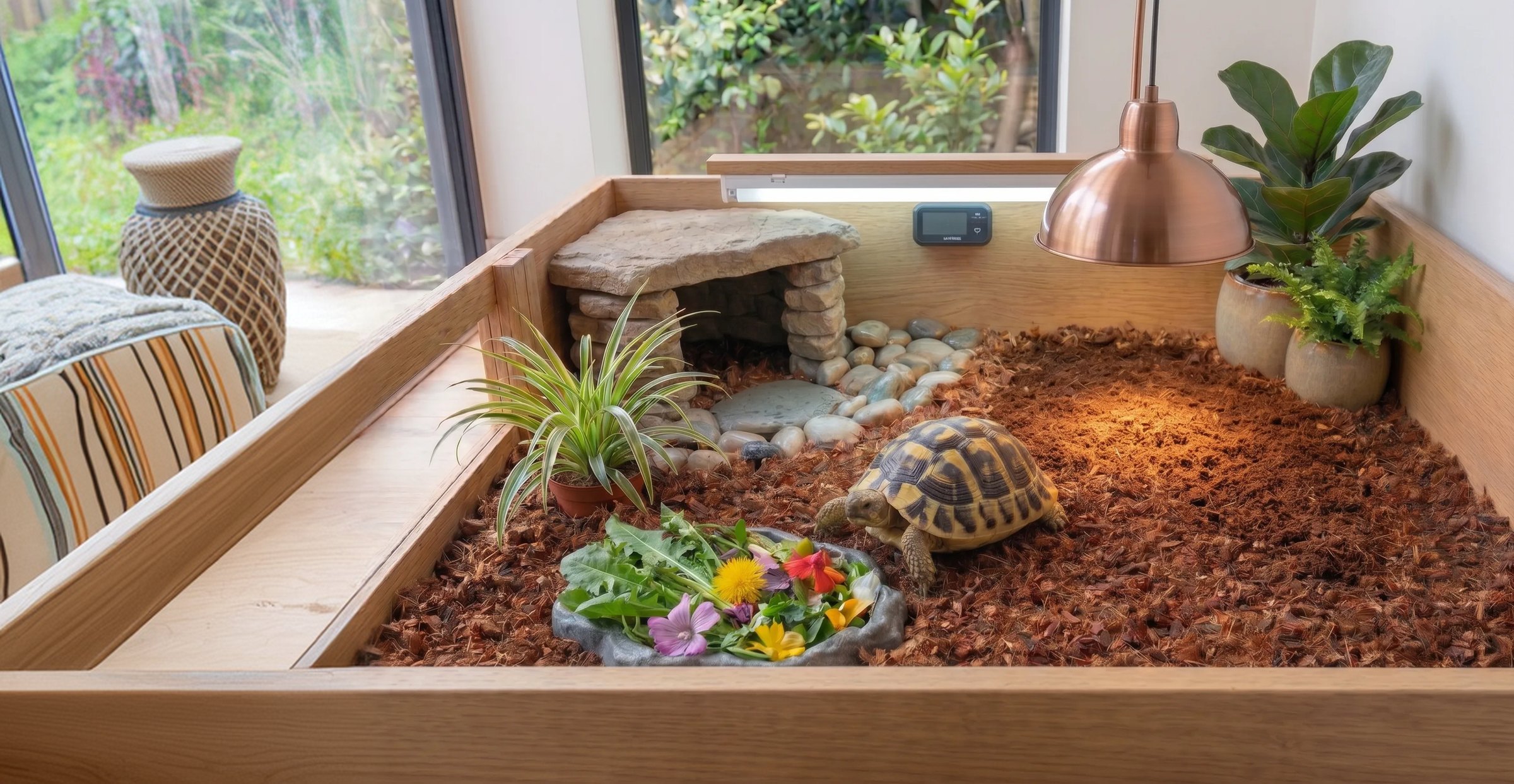
The simplest fix is an open-topped tortoise table rather than a vivarium. No glass, nothing to see through, nothing to climb towards.
It also happens to be what most tortoise specialists recommend anyway, for reasons beyond flipping — better airflow, unobstructed UVB, and room to dig.1 The one real counterargument is temperature: an open table takes its warmth from the room, so in a cold or draughty house a well-ventilated wooden vivarium may control heat better. That's a genuine trade-off.
If you're keeping a glass-fronted enclosure:
- Add a visual barrier along the lower part so your tortoise can't see through at eye level
- Remember its eye level is low — for a small species, the head may sit barely an inch above the substrate
- The higher the barrier, the less you can see in, so find the height that blocks your tortoise's view but still leaves you a window
Make them tall enough — and measure from the substrate
A low wall isn't mainly an escape risk. It's a flipping risk. A tortoise that can see over the edge will keep trying to get there, and climbing is what puts it on its back.
Two things to check, and you can do both by looking:
- Your tortoise can't see over the wall when it stretches up on its back legs
- Your tortoise can't reach the top edge to pull itself up
Measure from the top of the substrate, not the bottom of the enclosure. Four inches of substrate turns a 12-inch wall into an 8-inch barrier — which is why an enclosure that worked fine for months can suddenly produce climbing after you top the substrate up.
As a rough reference, guides often suggest somewhere around 12–18 inches above substrate for Mediterranean species like Hermann's, Horsfield's and Greek tortoises. A hatchling needs far less. A sulcata will outgrow anything you build indoors.
Fill in the corners
Corners cause more flips than anything else in the enclosure, and the reason is simple: a 90-degree corner gives your tortoise grip on two walls at once. It braces against both sides, works its way up — and then tips over backwards.
You don't need to block the corner off. You just need to remove the sharp angle.
Things that work, using what's probably already in the enclosure:
- A corner hide. Some are shaped to sit in a corner, and you get cover at the same time
- A plant pot tucked into the angle
- Piled-up substrate, banked into a gentle slope. Costs nothing, and slopes also give a flipped tortoise something to push against
- A small board cut to fit across the corner, turning the sharp point into a flat diagonal
One thing to check: make sure whatever fills the corner doesn't become the new climbing spot. A low hide with a solid top is fine. A tall pot with a rim to grab is trading one problem for another.
Keep food away from the edges
A small thing that keepers mention often. Food placed in a corner or against a wall draws your tortoise straight to the spot where it's most likely to flip — and if there's a water dish nearby, a flip can land it face-down in water.
Put food in the open, in the middle.
Don't strip it bare
Here's the part that surprises people.
The instinct after a flip is to take everything out, so there's nothing left to climb. That can backfire.
One keeper ran the test: hatchling sulcatas in a completely bare enclosure, with correct temperature and humidity but nothing in it. They started climbing the walls within 20 minutes and flipped within half an hour. Adding planting and cover stopped it immediately.
A tortoise with nowhere to hide feels exposed, and an exposed tortoise looks for a way out. An empty enclosure is a stressful enclosure.
Cover, not climbing frames
The distinction that matters:
- Cover — hides, low dense planting, visual barriers. These reduce stress and reduce wall-climbing. You want these.
- Climbable obstacles — tall rocks, stacked logs, anything that creates height and a drop. These cause flips. Be selective.
Practical guidance:
- Provide at least two hides — one on the warm side, one on the cool side
- Use low, dense planting for security rather than tall structures
- Add visual barriers so your tortoise can break line of sight and feel less exposed
Think about the floor
The surface matters enormously, because it determines whether a flip resolves itself in seconds or becomes an emergency.
A tortoise rights itself by pushing with head, neck and legs. It needs something to push against.
Good surfaces:
- Topsoil, coco coir, orchid bark, cypress mulch, soil-based mixes
- Leaf litter and grass outdoors
- Anything with texture and give
Bad surfaces:
- Bare tile, glass, smooth plastic
- Large areas of hard concrete outdoors
- Pure sand
Depth: 2–4 inches is a reasonable starting point for smaller species; burrowing species need more. Deep substrate also lets your tortoise dig, which is normal behaviour and reduces stress.
Slopes actually help
This one runs against instinct too. Gentle mounds and slopes give a flipped tortoise leverage — something to lean into and push against. A completely flat floor gives it nothing.
- Add gentle hills, mounds, gradual changes in level
- Avoid sharp drops and steep edges, which cause the flip in the first place
Audit everything that can be climbed
Go around the enclosure and look at each item as a tortoise would.
Water dish
- Shallow, with sloped or low sides that are easy to walk in and out of
- Heavy enough that it can't be tipped
- A classic flip cause: a tortoise climbing the rim and going over backwards
Hides
- Solid roof if your tortoise can get on top, or shaped so it can't climb up at all
- No gap between the hide and the wall where a tortoise can wedge itself
Rocks and logs
- Stable and unable to roll
- No steep faces or drop-offs
- No narrow gaps a tortoise can get stuck in and tip over trying to escape
Plants
- Low and dense is safer than tall and structural
- Watch for planting a tortoise can climb onto and slip off
- One keeper lost a hatchling that flipped on vegetation, landed in a warm spot, and couldn't get back
Where the heat is matters most
This is the single most important safety decision in the whole enclosure.
A tortoise that flips in a shaded corner has time. A tortoise that flips under the basking lamp does not. It can't move away from the heat, and overheating and dehydration set in fast.
- Put the basking lamp at one end, with a clear cool zone at the other
- Make sure the area under the lamp is flip-safe — no climbable furniture, no water dish rim, no obstacles directly beneath it
- Keep the substrate under the basking area grippy, not smooth
- Run heat on a thermostat and verify temperatures with a thermometer rather than trusting a bulb rating
- Outdoors, always provide real shade — planting, a shelter, or a shaded end of the pen
If you change only one thing after reading this, make it this one: look at what's directly under your heat source, and remove anything that could cause a flip there.
If you keep more than one tortoise
Mating attempts and territorial ramming are a genuine cause of flips, and they're easy to miss because they happen while you're not watching.
- Give more space than you would for a single tortoise
- Use visual barriers so tortoises can get out of each other's sight
- Watch for a tortoise that's being persistently pursued — separation is sometimes the answer
- Be especially careful with a single male and a single female, which is a common recipe for constant harassment
Health affects flipping too
A tortoise that isn't well flips more, and recovers less easily.
- Metabolic bone disease weakens the skeleton and shell, making tortoises unsteady. Proper UVB, calcium and diet are the prevention.
- Pyramiding — the lumpy shell growth caused by poor early husbandry — can change shell geometry in ways that make righting harder. Correct humidity and diet for young tortoises matter here.
- A tortoise that suddenly starts flipping when it never used to is worth a vet visit. It can indicate a respiratory infection, weakness or a neurological problem.
Extra care for hatchlings
Young tortoises flip far more than adults. They're energetic, they climb everything, and they haven't learned their enclosure yet.
For very young tortoises:
- Be stricter about climbable furniture than you would for an adult
- Still provide cover and hides — bare is not the answer
- Keep the water dish very shallow with easily walkable sides
- Check on them more often, particularly in hot weather
One thing that isn't about flipping
While you're building: air out a new enclosure before your tortoise goes in.
The material itself is rarely the problem — but adhesives, sealants and paints can give off fumes, especially when they're new and warmed by a basking lamp. Let everything cure fully, and if you put your head in and smell chemicals, it isn't ready.
Quick checklist
Walk your enclosure and check each one:
- Walls are opaque at tortoise eye level
- Walls are tall enough — at least twice shell length
- No sharp 90-degree corners
- At least two hides, warm side and cool side
- Low planting and visual barriers for security
- Substrate deep enough and grippy, not bare hard surface
- Gentle slopes, no sharp drops
- Water dish shallow, stable, easy to exit
- Nothing climbable directly under the basking lamp
- Real shade available at all times
- Rocks and logs stable, no wedging gaps
- Temperatures verified with a thermometer, not assumed
And when it still happens
Even a well-designed enclosure will produce the occasional flip. That's normal, and it's not a sign you've done something wrong.
What matters is that when it happens, your tortoise lands somewhere it can push against, out of direct heat — and that someone notices.
Sources
- "Creating the Ideal Enclosure for your Chelonian." https://mysulcatarescue.org/the-ideal-enclosure
- The Tortoise Spot, Habitat & Enclosure Guide. https://thetortoisespot.com/habitat/
- The Tortoise Spot, Indoor Enclosure Setup. https://thetortoisespot.com/habitats-and-enclosures/indoor-enclosure/
- Tortoise Forum, keeper discussions on visual barriers, corner design and hatchling flipping. https://tortoiseforum.org
- Ewart, H.E. et al. (2022). "The metabolic cost of turning right side up in the Mediterranean spur-thighed tortoise (Testudo graeca)." Scientific Reports 12, 431.
Note: enclosure design guidance comes from experienced keepers, rescues and husbandry references rather than controlled studies. There is very little formal research on flipping in captive tortoises. Where we've included a keeper's observation, we've said so.
This is general information for tortoise keepers, not veterinary advice. Requirements vary by species — check guidance for your own tortoise.
Footnotes
-
Tortoise Trust, "Indoor Accommodation for Tortoises: A Practical Guide." https://www.tortoisetrust.com/post/indoor-accommodation-for-tortoises-a-practical-guide ↩