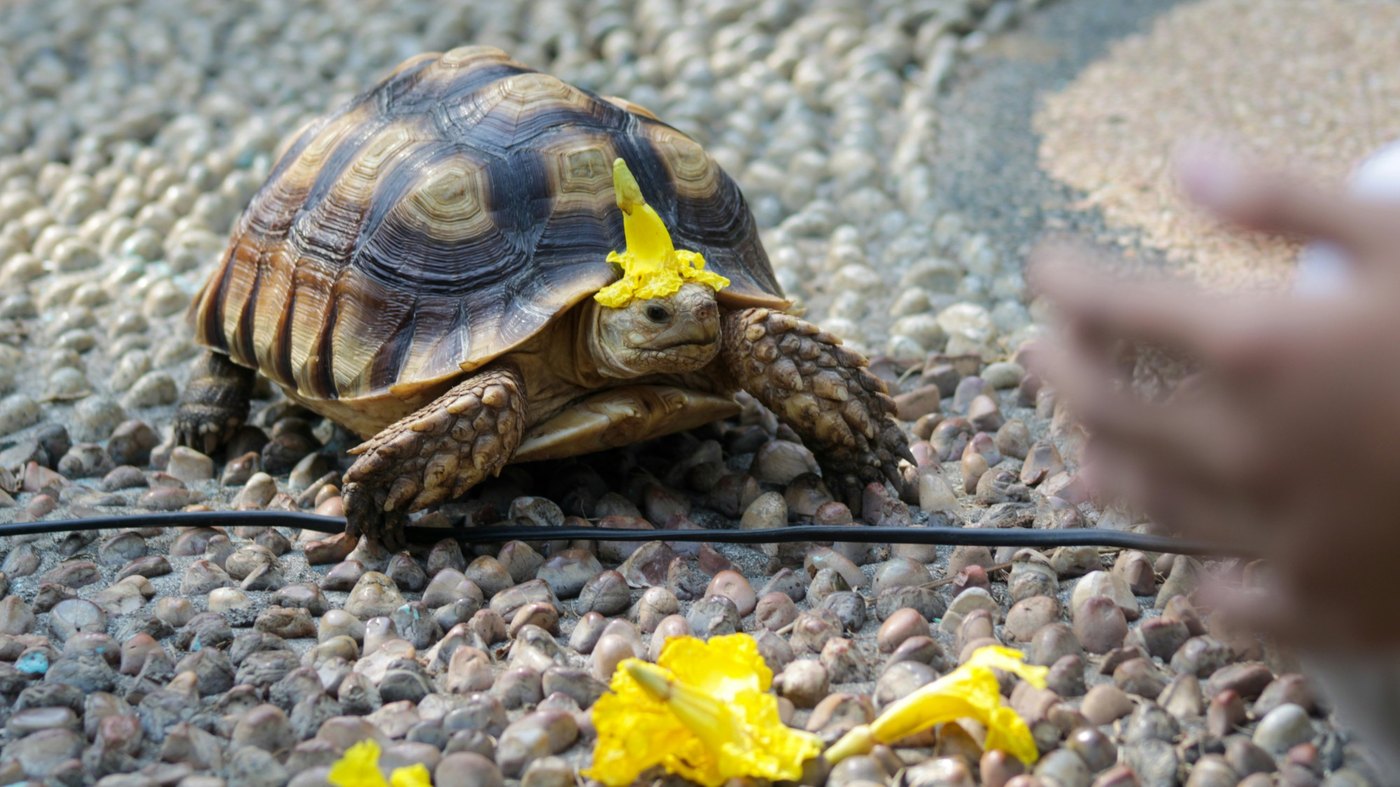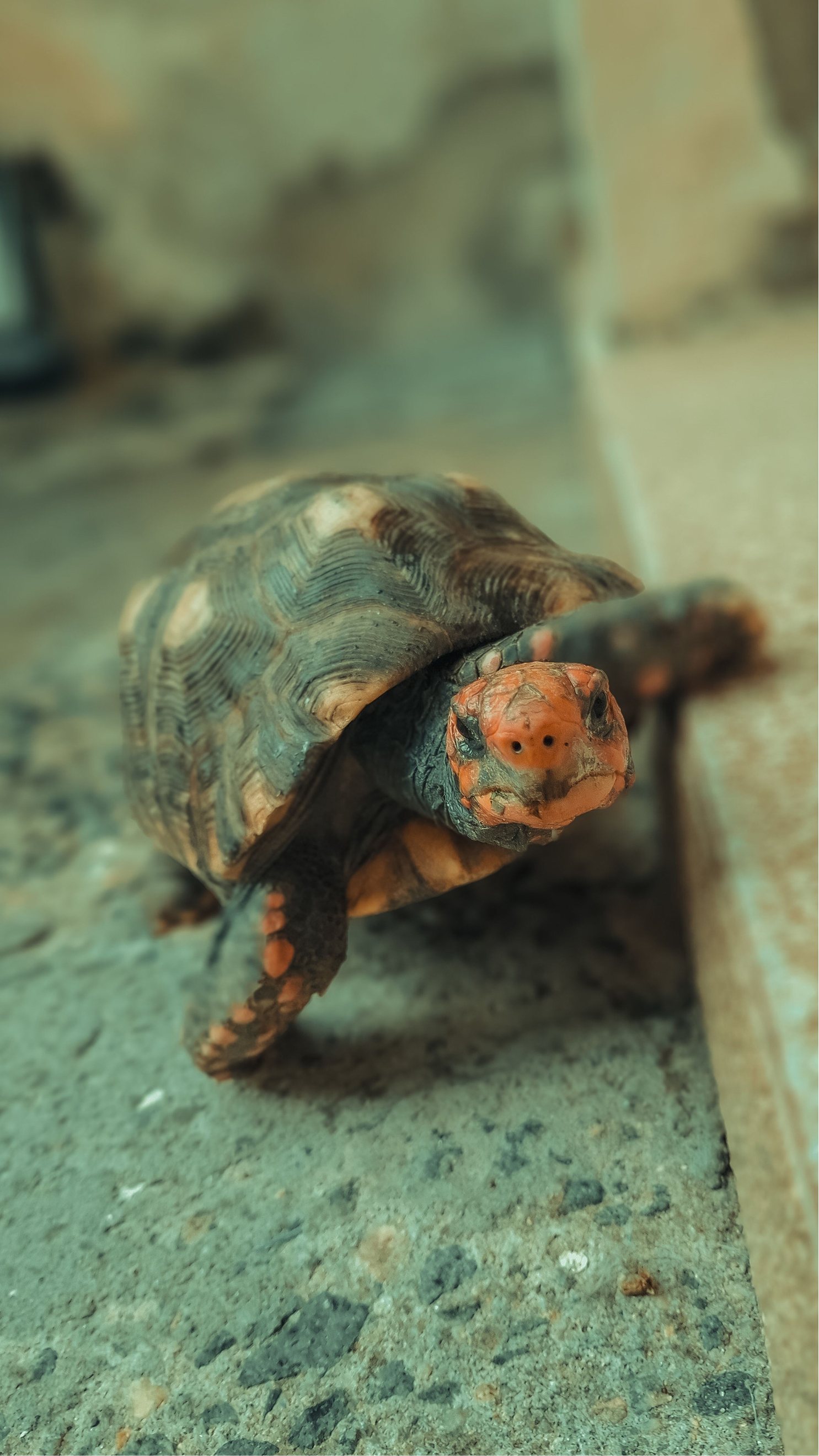
Found your tortoise on its back? Turn it over gently, move it out of any direct heat, and put it somewhere calm. Then come back and read this.
Most tortoises that flip manage to turn themselves back over. But not all of them, and not always fast enough. Here's what's actually happening while your tortoise is upside down — and why some get out of it easily while others can't.
What happens when a tortoise is on its back
It struggles to breathe
A tortoise can't expand its chest the way we do. Its ribs are fused to the shell, so it breathes by shifting its organs against its lungs — and those lungs sit right up under the top of the shell.
Flip the tortoise over, and all that weight now presses down on the lungs. Researchers studying self-righting in spur-thighed tortoises specifically noted how much the restricted breathing adds to the strain.1
That's why an upside-down tortoise often looks like it's puffing. It's working hard just to breathe.
Turning back over is exhausting
This is the part most keepers don't realise.
Scientists measured exactly how much energy it takes for a tortoise to right itself, and compared it to walking. The result: righting itself costs about twice the power of walking.1
So a tortoise that flips a lot isn't just having a bad day. Every flip drains it, and it's doing that hard work while it can barely breathe.
Heat is the fastest danger
A tortoise on its back can't move. It can't crawl into the shade, and it can't get away from a basking lamp.
- Under a heat lamp or in direct sun, overheating and dehydration set in fast
- The research on self-righting lists thermal stress and dehydration among the real dangers of failing to turn back over12
- Rescues put it plainly: check outdoor pens in hot weather, because a flipped tortoise can overheat quickly3
This is the risk that turns a mishap into an emergency. A flip in a shady corner is a very different situation from a flip under a basking lamp.
Other things vets warn about
Veterinary writing on flipped tortoises also mentions:
- Twisting of the gut — a serious condition that needs urgent treatment
- Emptying the bladder in panic — which matters more than it sounds, because tortoises store water in their bladder and rely on it to stay hydrated4
We're including these because keepers and vets quote them often. But the original source is an old veterinary article we couldn't track down, so treat them as clinical experience rather than proven findings.
Why tortoises flip in the first place
Almost every flip comes down to one of a handful of causes.
Climbing. This is by far the most common. Tortoises are curious and surprisingly determined climbers, but they're built low and heavy — not agile. A tumble from a water dish, a hide, a rock or a log can easily land one on its back.
Corners. Tortoises are drawn to corners and will work at them persistently, trying to climb out. A 90-degree corner gives them just enough purchase to get partway up — and then tip backwards.
See-through walls. A tortoise that can see out will spend hours trying to get there. Glass and clear plastic are a common trigger for wall-climbing, and wall-climbing is a common trigger for flipping.
Boredom and stress. One keeper ran a simple experiment: hatchling sulcatas placed in a bare enclosure — correct temperature and humidity, but nothing in it — started climbing the walls within 20 minutes and had flipped within half an hour. When cover and planting were added, the wall-climbing stopped.
That's worth sitting with, because it's the opposite of what most people assume. Stripping an enclosure bare to stop flipping can make it worse. A tortoise with nowhere to hide feels exposed, and an exposed tortoise looks for a way out.
Mating and squabbles. Males mounting females can tip them over, and males will ram each other. If you keep more than one tortoise, this is a real cause.
Illness. A tortoise that's weak, wobbly or unsteady flips more easily. Metabolic bone disease in particular weakens the shell and skeleton and makes tortoises less stable on their feet.
Which tortoises flip most
Young ones, by a long way
Hatchlings and juveniles flip far more often than adults. Keepers regularly describe young sulcatas flipping every single day.
There's a reason for it:
- They're more energetic and climb more
- They haven't learned their enclosure yet
- They're light enough to be tipped by small obstacles
The flip side — literally — is that young tortoises are usually better at righting themselves. Their necks and legs are proportionally longer, which gives them more leverage.5
So with a juvenile you'll see more flips, but a higher proportion resolve on their own. That's reassuring right up until the one that doesn't.
Tortoises with shell problems
This one is well worth knowing about. A tortoise whose shell has developed abnormally — pyramiding from poor early husbandry, or deformity from metabolic bone disease — can be noticeably more flip-prone, and can struggle more to recover.
Keepers report individual tortoises with flattened or pyramided shells that flip repeatedly while every other tortoise in the same enclosure never does.
What about species?
You'll see claims online that certain species flip more than others. The honest position is that this isn't well established — most of it is keeper observation rather than research, and it's hard to separate species from the enclosures those species tend to be kept in.
What the research does show is that shell shape affects how easily a tortoise rights itself once it's over.2 Whether it affects how often it tips in the first place is much less clear.
Why some tortoises can right themselves and others can't
Shell shape
This is the biggest factor, and it has nothing to do with how hard your tortoise tries.
- A study of 89 Galápagos tortoises found that saddleback shells need more energy to right than domed ones2
- Other research shows that slight asymmetries in shell curvature can help a tortoise roll back almost by itself6
In short: a high domed shell is more stable upright, but flatter or more irregular shells can behave unpredictably once flipped.
What it's lying on
A tortoise rights itself by pushing with its head, neck and legs hard enough to tip past the balance point.1 To do that, it needs something to push against.
- Good: soil, leaf litter, uneven ground, slopes
- Bad: tile, glass, smooth plastic, a bare enclosure floor
The same tortoise that flips back easily in the garden can be genuinely stuck on a smooth indoor floor.
Age and size
Research on turtles found that younger animals righted themselves about twice as fast as older ones, because their necks are proportionally longer.5
That particular study was on snapping turtles, which use their necks differently from tortoises — so don't read it too literally. But the general point holds: body proportions change with age, and so does the ability to recover from a flip.
General health
Righting already costs double what walking does. A tortoise that is:
- unwell or underweight
- dehydrated
- too cold
- just out of brumation
has far less in reserve. The same flip a healthy tortoise shrugs off can defeat one that isn't at its best.
So how long is too long?
We're not going to give you a number, because nobody has actually measured it.
You'll find articles claiming a tortoise can survive four hours upside down, sometimes citing a named study. We looked for that study and couldn't find it. We wouldn't rely on it, and we'd suggest you don't either.
Here's what we do know:
- Righting is exhausting, so a struggling tortoise is already running low1
- Breathing is restricted the whole time1
- Heat makes everything worse, fast23
- Temperature, surface, shell shape and the individual animal all change the outcome
The practical answer: there's no safe amount of time. What matters most is where it happened. Shade and soil buy you time. A basking lamp and a hard floor don't.
What to do if you find your tortoise on its back
- Turn it over gently. Support the shell, and set it down where it has grip.
- Get it away from heat. Move it out of the sun or away from the basking lamp.
- Offer a shallow warm soak. If it's been a while, dehydration is a real concern — especially if it emptied its bladder.
- Watch how it breathes. Laboured or open-mouth breathing, nasal discharge, lethargy or not responding are all reasons to call a reptile vet.
- Don't assume it's fine just because it walks away. Tortoises hide illness well, and some effects aren't visible straight away.
What this means for you
Two things come out of all this.
Flipping isn't trivial. Even when your tortoise rights itself, it's paid a real price. And a flip in the wrong spot at the wrong time is an emergency, not an accident.
Most of the risk is in the enclosure, not the tortoise. You can't change your tortoise's shell shape. You can change the surface, the slopes, what it climbs, where the heat is and where the shade is.
That's where prevention actually happens — and it's what our next guide is about: designing an enclosure that reduces flipping.
Sources
This is general information for tortoise keepers, not veterinary advice. If your tortoise is unwell, contact a vet with reptile experience.
Footnotes
-
Ewart, H.E., Tickle, P.G., Sellers, W.I., Codd, J.R. et al. (2022). "The metabolic cost of turning right side up in the Mediterranean spur-thighed tortoise (Testudo graeca)." Scientific Reports 12, 431. https://www.nature.com/articles/s41598-021-04273-w ↩ ↩2 ↩3 ↩4 ↩5 ↩6
-
Chiari, Y. et al. (2017). "Self-righting potential and the evolution of shell shape in Galápagos tortoises." Scientific Reports 7, 15828. https://www.nature.com/articles/s41598-017-15787-7 ↩ ↩2 ↩3 ↩4
-
"Creating the Ideal Enclosure for your Chelonian." https://mysulcatarescue.org/the-ideal-enclosure ↩ ↩2
-
Mader, D. and Palazzolo, C. (1991). Tortuga Gazette, January 1991. Widely quoted in keeper communities; original publication not verified. ↩
-
"Turning turtle: scaling relationships and self-righting ability in Chelydra serpentina." Conducted on snapping turtles, which right themselves using the neck. ↩ ↩2
-
"Symmetry-Breaking Stabilities in Carapace Curvature on Testudo (Reptilia, Testudinidae)" (2022). https://www.ncbi.nlm.nih.gov/pmc/articles/PMC8868250/ ↩